
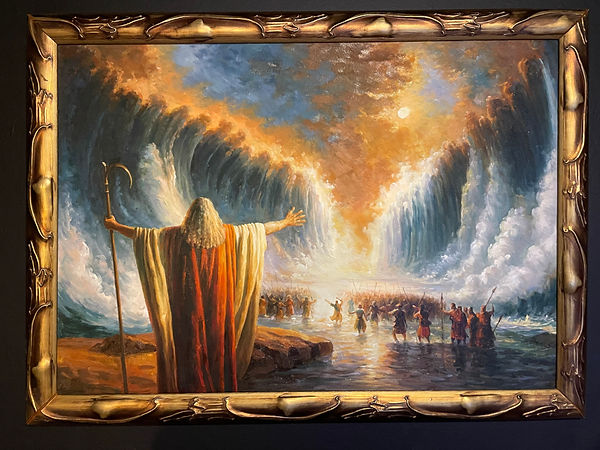
Exodus 14
a m e s s a g e o f f a i t h
“Exodus 14”
Rembrandt, (imagined - 1669)
Oil on canvas, 55 x 80 cm (framed)
“Then Moses stretched out his hand over the sea, and the Lord drove the sea back by a strong east wind all night and made the sea dry land, and the waters were divided. And the Israelites went into the midst of the sea on dry ground, with the waters forming a wall for them on their right hand and on their left.”
— Exodus 14 : 21–22
September 1669.
In the Rozengracht district, the rented house creaks like an old boat. Titus has already left; Saskia, Hendrickje, the friends — all are gone. Only the smell of turpentine, the creak of the easel, and the Bible open on his chest remain.
Rembrandt no longer paints for the world.
He paints to cross over…
His faith was not a choir hymn; it was a hoarse sigh in the dark.
As a boy in Leiden, he heard his mother read Genesis by candlelight. At twenty, he drew the prodigal son kneeling — himself, anticipating the future. At fifty, he embraced the same son in thick paint with the work The Return of the Prodigal Son (1668) — the father embracing the dirty son, as God would embrace him, as one who asks forgiveness from God for having been human.
Now, at sixty-three, with swollen fingers and a failing heart, he chooses Exodus 14 — not as a spectacle of realism, but as a message of faith and passage.
His hands are already far too weak and tired for many details and allegories; here the focus is the message of Faith, a legacy that Rembrandt would leave to the world.
Moses is he: stooped back, blood-red mantle like an open wound, trembling staff like the last brush.
The sea does not roar; it whispers.
The walls of water are not ramparts — they are translucent veils of light, painted with impasto so thick they seem to breathe God’s breath.
The dry path is narrow, almost a tomb corridor.
From the hands of an old, tired Rembrandt, with only a few days of life ahead, figures emerge with quick and simplistic strokes, yet with a deep message of Faith.
The light does not fall from above; it is born within the water, as if the sea carried the sun in its womb.
Cream-white, wound-blue, hope-green — layer upon layer, palette knife, fingers, nails.
Each brushstroke is a prayer.
Each groove in the dark paint is a psalm.
He knows he will not cross. Like Moses he will see the land, but will not enter it.
He painted the path — so that someone, someday, may walk it.
On the canvas, the sea opens.
In the room, the old man ceases to exist.
Rembrandt’s faith was not dogma; it was experience.
Baptized in the Dutch Reformed Church in 1606, he grew up in a country where the Bible was read at home, not only in church. He was never a theologian, but he lived Scripture as human drama:
-
At 20, he painted The Parable of the Prodigal Son (1627) — a young man who squanders everything, as he himself would.
-
At 30, The Angel Leaving Tobias (1637) — a farewell that would echo in Saskia’s death.
-
At 50, The Return of the Prodigal Son (1668) — the father embracing the dirty son, as God would embrace him.
More than a hundred biblical works came from his hands — not for fashion, but for necessity. When he lost the house, the goods, the family, the Bible was what remained.
His last years were of silent conversion:
-
1661: he paints The Apostles at the Tomb — ordinary men, frightened, before the void.
-
1663: The Circumcision — a simple ritual, almost domestic.
-
1668: The Return — the embrace he never received from men, but believed he would receive from God.
“I painted the sea parted to gladden God, as testimony of my Faith
and so that, closing my eyes, I might walk.”
More about Rembrandt
Rembrandt Harmenszoon van Rijn (1606–1669) was a Dutch painter and printmaker, a Baroque master and one of the greatest artists in Western art history. Born in Leiden to a miller’s family, he trained with local masters before settling in Amsterdam, where he gained early fame with portraits and history paintings. His work, defined by an unmatched command of light and shadow—the famed chiaroscuro—probes the psychological depth of his subjects, exposing complex emotions and raw humanity.
Unlike Renaissance idealization, Rembrandt painted unvarnished truth: wrinkles, weary gazes, hesitant gestures. Masterpieces like The Night Watch (1642), The Return of the Prodigal Son (c. 1669), and his many self-portraits trace a stylistic evolution from refined early detail to the loose, expressive brushwork of his later years. Despite early success, he faced bankruptcy, the deaths of his wife Saskia and son Titus, and social isolation—yet never ceased creating. His influence spans centuries, shaping Romanticism to modern Expressionism. Rembrandt did not merely master technique; he humanized art, turning canvas and copper into mirrors of the soul.

